
The Best Fluffy Pancakes recipe you will fall in love with. Full of tips and tricks to help you make the best pancakes.

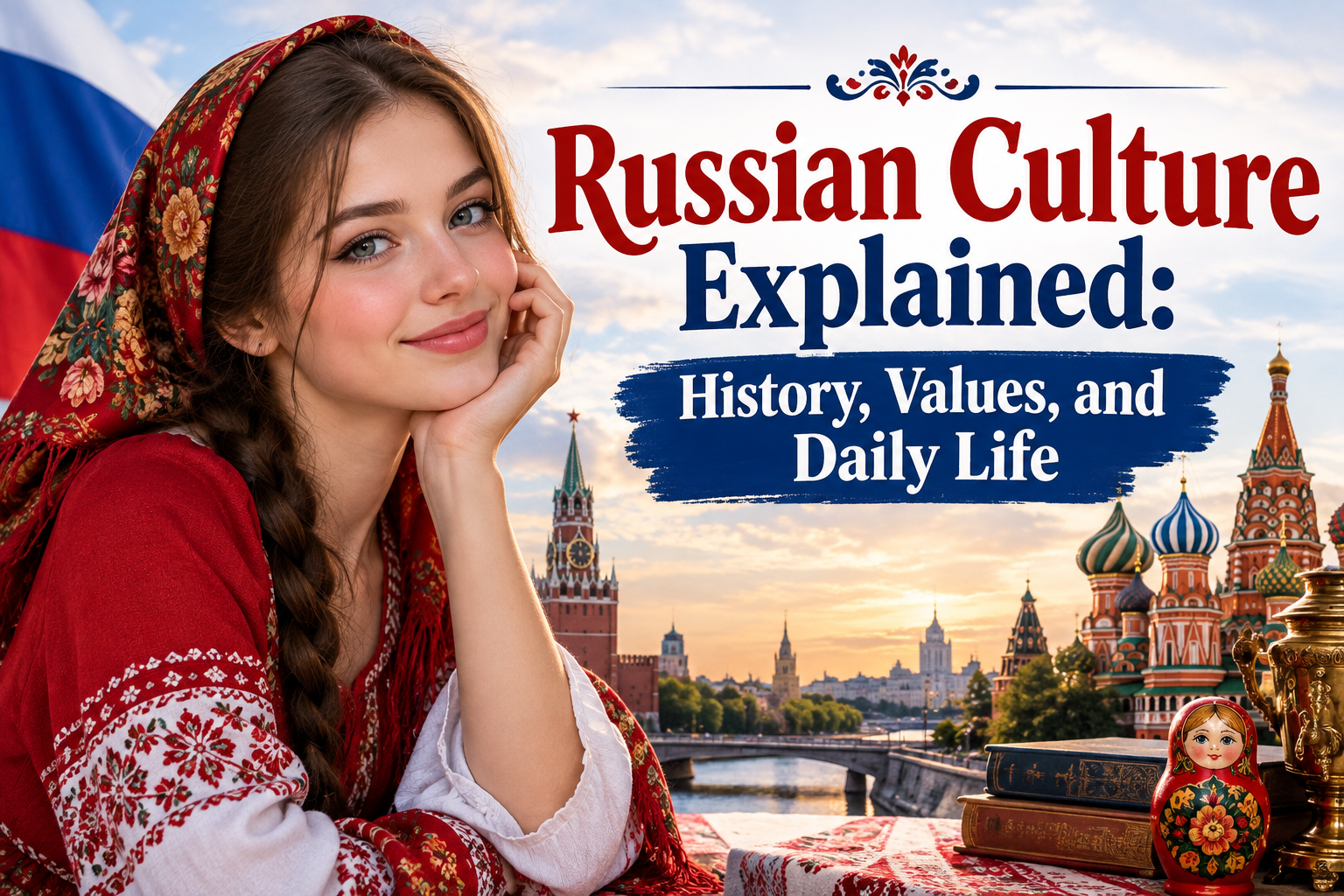
Russian culture carries the weight of a nation that spans eleven time zones, two continents, and a history defined by extremes — imperial grandeur, revolutionary upheaval, and a literary and artistic tradition that shaped world culture far beyond its own borders. Understanding it means holding two things at once: a country whose historical identity was shaped for centuries by the Orthodox Church and imperial rule, and a modern nation still working through the aftershocks of a dramatically different 20th century than most of the world experienced.
This guide covers the historical and religious foundations that shaped Russian culture, along with the values, traditions, and daily life that define it today.
A Civilization Shaped by Distance and Endurance
Russia’s sheer geographic scale has shaped its national character in ways smaller countries never had to contend with — vast distances, harsh winters, and a historically agrarian population spread across an enormous territory bred a cultural emphasis on endurance, resilience, and self-reliance that still runs through Russian identity today. The country’s position straddling Europe and Asia has also produced a genuinely distinct cultural identity, influenced by both Western European traditions and its own Slavic and Central Asian neighbors, without fully belonging to either sphere in the way outsiders sometimes assume.
Orthodox Christianity’s Deep Cultural Roots
Russian Orthodox Christianity, adopted over a thousand years ago following the conversion of Kievan Rus, remains one of the most influential forces in Russian cultural identity, shaping art, architecture, and social values well beyond religious practice alone. The onion-domed churches recognizable around the world reflect a distinct architectural and artistic tradition tied directly to Orthodox worship, and religious holidays and customs remain culturally significant even among Russians who wouldn’t describe themselves as strictly devout in daily practice. Decades of state-enforced secularism during the Soviet period suppressed open religious practice considerably, but Orthodox Christianity has seen a genuine resurgence in cultural and religious life in the years since, reclaiming much of its historical role in shaping national identity.
A Literary Tradition That Shaped the World
Few countries can claim a literary tradition with the global influence Russia’s has had — Tolstoy, Dostoevsky, Chekhov, and Pushkin, among many others, produced work that reshaped world literature and remains deeply embedded in Russian cultural identity and education today. Literature in Russian culture has historically carried weight beyond entertainment, often functioning as a vehicle for moral and philosophical exploration during periods when open political expression carried real risk. This tradition extends into a broader cultural reverence for the arts more generally — Russian ballet, classical music, and theater carry similarly outsized global influence relative to the country’s size, reflecting a long-standing cultural value placed on artistic and intellectual achievement.
Family and Hospitality as Enduring Values
Family remains central to Russian social life, with strong ties across generations and a cultural expectation of mutual support that extends well beyond the immediate household, particularly in the aftermath of economic hardship during and after the Soviet collapse, when extended family networks often served as essential practical support systems. Hospitality carries genuine cultural weight as well — guests are typically offered food and drink as a matter of course, and the concept of generously feeding visitors, sometimes to the point of good-natured insistence, reflects a deeply held value around welcoming others rather than simple politeness alone.
The Weight of the 20th Century
Understanding modern Russian culture requires understanding just how dramatically the 20th century reshaped it — the 1917 revolution, decades of Soviet rule, state-enforced atheism, and the Soviet Union’s eventual collapse in 1991 all left lasting marks on Russian society that persist in ways both visible and subtle. Soviet-era values around collective identity, work, and social structure coexist today alongside a return to pre-revolutionary traditions and religious practice, creating a cultural landscape shaped by genuinely competing historical influences rather than a single continuous thread. This history also explains a cultural tendency toward resilience and stoicism that outside observers sometimes read as coldness, but which reflects a national experience with hardship that shaped generations.
What’s Actually on the Table
Russian cuisine reflects the country’s history and climate, built around hearty, warming dishes suited to long winters — borscht (beet soup), pelmeni (dumplings), and blini (thin pancakes) remain staples across the country, alongside regional variations shaped by Russia’s enormous geographic diversity. Bread carries particular cultural and even symbolic weight, tied historically to hospitality and, during periods of hardship, basic survival. Tea holds real social significance too, traditionally served from a samovar and central to informal gatherings and hospitality customs that remain very much alive today.
Festivals That Reflect Both Faith and History
New Year’s, rather than Christmas, stands as Russia’s most significant secular holiday, a legacy of the Soviet era when religious celebrations were suppressed and New Year’s absorbed many of the traditions — gift-giving, decorated trees, family gatherings — that Christmas carries in much of the Western world. Orthodox Christmas, observed according to the older Julian calendar and falling in early January, has regained prominence as a religious holiday in the years since the Soviet collapse, existing alongside the secular New Year’s celebration rather than replacing it. Victory Day, commemorating the end of World War II, remains one of the most significant and emotionally resonant national holidays, reflecting the immense scale of loss Russia experienced during the war and its lasting place in national memory.
Misconceptions Worth Correcting
Assuming Russian culture is uniform across the entire country ignores enormous regional and ethnic diversity within Russia’s borders — dozens of ethnic groups and distinct regional cultures exist within the country, particularly across its vast Siberian and Caucasus regions, each with traditions and identities that don’t reduce neatly to a single national culture.
Treating Soviet and Russian culture as identical misses an important distinction — Soviet ideology actively suppressed many pre-revolutionary Russian traditions, and post-Soviet Russia has involved a genuine, ongoing process of reclaiming and reinterpreting cultural and religious traditions that were deliberately set aside for decades.
Assuming Russian hospitality or family values are performative rather than genuine underestimates how deeply rooted these values actually are, shaped by historical necessity as much as cultural preference.
An Influence That Reaches Far Beyond Russia’s Borders
Russian literature, classical music, and ballet have shaped global culture in ways that continue to influence artistic tradition well beyond the country’s own borders, a testament to a cultural emphasis on artistic achievement that outlasted even the dramatic political upheavals of the 20th century. If you’re interested in how other nations balance deep historical continuity with a genuinely transformative modern history, our guide to Chinese culture explores a similarly layered relationship between ancient tradition and 20th-century political transformation.
Frequently Asked Questions
What religion is most common in Russia? Russian Orthodox Christianity is the majority religion, deeply tied to national cultural identity, though decades of Soviet-era secularism significantly suppressed open religious practice before its resurgence in recent decades.
Why is New Year’s more significant than Christmas in Russia? During the Soviet era, religious Christmas celebrations were suppressed, and New Year’s absorbed many of the associated traditions like gift-giving and decorated trees, a pattern that has largely persisted even as Orthodox Christmas has regained religious significance.
Why is Russian literature so globally influential? Writers like Tolstoy, Dostoevsky, and Chekhov produced work that reshaped world literature, and literature in Russian culture has historically carried significant weight as a vehicle for moral and philosophical exploration.
How did the Soviet era affect Russian culture? It suppressed many pre-revolutionary traditions, particularly religious practice, while introducing its own values around collective identity, and modern Russian culture reflects an ongoing blend of both Soviet-era and reclaimed pre-revolutionary influences.
Where This Leaves You
Russian culture is best understood through the lens of endurance — a nation shaped by vast geography, harsh history, and a literary and artistic tradition that reshaped world culture despite, or perhaps partly because of, the scale of upheaval it endured throughout the 20th century. From Orthodox Christianity’s deep roots to a family and hospitality culture forged partly through historical hardship, Russian identity reflects a genuinely layered relationship between deep historical tradition and dramatic modern transformation.
For further reading on Russian cultural heritage and traditions, the UNESCO World Heritage listings for Russia are a reliable, authoritative resource.