
The Best Fluffy Pancakes recipe you will fall in love with. Full of tips and tricks to help you make the best pancakes.

Introduction
Electric vehicles have moved from a niche choice to the default option for millions of drivers. In 2026, prices dropped sharply across the board after the U.S. federal EV tax credit expired in October 2025 — meaning many EVs are now cheaper than they were last year, even without the credit.
This guide compares the best electric vehicles of 2026 with real, current pricing and EPA-estimated range (updated August 2026), so you can shop with confidence whether you want a budget-friendly commuter or a family SUV. Every range number in this guide is the EPA-estimated figure, not the manufacturer’s optimistic marketing claim — and if you want to double-check any of them yourself, the official EPA fuel economy database lets you look up the certified numbers for any model in seconds. government EPA fuel economy site before buying.
2026 has turned out to be an unusual year for EV shoppers. The federal $7,500 tax credit that pushed many buyers toward electric cars expired at the end of September 2025, and on paper that should have made EVs less attractive. Instead, automakers responded by cutting sticker prices directly — in some cases by nearly $10,000 — so that many EVs are actually cheaper to buy today than they were a year ago, even without any government incentive. If you’re also comparing EVs against smart home upgrades or other big-ticket tech purchases this year, our smart home technology guide covers a similar buyer’s-guide approach for the connected home.
Quick Answer: Best EVs of 2026 at a Glance
| Model | Starting Price (2026) | EPA Range | Best For |
|---|---|---|---|
| Hyundai Ioniq 5 (SE Standard Range) | ~$35,000 | 245 mi | Best value / cheapest entry |
| Ford Mustang Mach-E (Select RWD) | ~$37,995 | 260 mi | Driving feel / style |
| Tesla Model 3 (Standard) | ~$36,990–38,380 | 363 mi | Best range for the price |
| Kia EV6 (Light) | ~$37,900–39,445 | 232–237 mi | Warranty (10 yr/100k mi) |
| Tesla Model Y (RWD) | ~$39,990 | 321 mi | Best-selling family EV |
| Volvo EX30 | Check current local pricing | Compact | Best compact/city EV |
| BMW i4 | Check current local pricing | — | Luxury/performance feel |
Prices are U.S. MSRP before destination fees, taxes, and any state/local incentives, and change often — always confirm on the automaker’s site before buying.
Why More Drivers Are Choosing Electric Vehicles
Lower Running Costs
Electricity typically costs less than gasoline per mile, and EVs have far fewer moving parts, cutting maintenance costs.
No More Federal Tax Credit — But Prices Dropped Anyway
The $7,500 federal EV tax credit expired on September 30, 2025, under the One Big Beautiful Bill Act, along with the $4,000 used-EV credit. In response, automakers like Hyundai and Kia cut sticker prices by $5,000–$9,800 to stay competitive — so EVs are still a strong deal in 2026, just through direct price cuts instead of a tax credit. One credit that does remain active is the 30C home charger tax credit, covering 30% of installation costs (up to $1,000) through June 30, 2026 — worth checking before you install a Level 2 charger. State-level incentives also vary widely, so it’s worth checking your local Department of Motor Vehicles or energy office before you buy, since some states still offer $1,000–$5,000 in rebates on top of manufacturer discounts.
Quiet, Smooth, Quick
Electric motors deliver instant torque, so even affordable EVs feel quick off the line.
Fast Charging Is the New Normal
Most 2026 EVs on this list charge on 800V architecture, adding 150–180 miles of range in under 20 minutes at a fast charger.
The Charging Port War Is Basically Over
For years, EV buyers had to worry about which charging plug their car used — CCS, NACS, or something else entirely. That confusion is fading fast. Tesla’s NACS (North American Charging Standard) connector is now standard or available on nearly every major EV brand, including Hyundai, Kia, Ford, and GM, which means most new EVs can now plug directly into Tesla’s Supercharger network without an adapter. This matters in practice: Tesla’s Supercharger network is still the largest and most reliable fast-charging network in North America, so a car with native NACS access effectively has a bigger “safety net” for road trips than one that doesn’t.
If you’re deciding between models, ask specifically whether NACS is built in or requires a separate adapter — it can meaningfully change how convenient long trips are.
Best EVs to Consider in 2026
1. Tesla Model 3 — Best Range for the Price
The Model 3 lineup for 2026 spans four trims:
- Standard: ~$36,990–38,380, 363 miles range
- Premium RWD: ~$42,490, 363 miles
- Premium AWD: ~$47,490, 346 miles
- Performance: ~$54,990–56,380, 309 miles, 0–60 mph in 2.9 seconds
Best for: Buyers who want the longest range per dollar in a sedan.
2. Hyundai Ioniq 5 — Best Value
Hyundai cut Ioniq 5 prices by up to $9,800 for 2026:
- SE Standard Range: ~$35,000, 245 miles
- SE (long-range RWD): ~$37,500, 318 miles
- Native NACS port — plugs directly into Tesla Superchargers, no adapter needed
- 10–80% DC fast charge in about 20 minutes
Best for: First-time EV buyers wanting the lowest entry price with real range.
3. Kia EV6 — Best Warranty
- Light: ~$37,900–39,445, 232–237 miles
- Wind: ~$44,800–46,345, up to 319 miles
- GT-Line: ~$50,245
- Shares its fast 800V platform with the Ioniq 5
- Kia’s 10-year/100,000-mile powertrain warranty is the longest in the segment
Best for: Buyers who want long-term peace of mind.
4. Tesla Model Y — Best-Selling Family EV
- RWD: ~$39,990, 321 miles
- Long Range RWD: ~$44,990, 357 miles
- Premium: ~$46,630+
Growing families who need room for strollers, luggage, or sports gear, plus the peace of mind of the largest fast-charging network on road trips. If you’re cross-shopping electric SUVs against gas-powered luxury SUVs, our luxury SUV buying guide covers the traditional side of that comparison.
5. Ford Mustang Mach-E — Best Driving Feel
- Select RWD: ~$37,795–37,995, 260 miles
- GT trim: 480 hp, 3.3-second 0–60
- NACS adapter gives access to Tesla Superchargers
Best for: Buyers who want an EV that’s genuinely fun to drive.
6. BMW i4 — Best Luxury Feel
Premium interior, strong acceleration, and BMW’s usual ride quality. Check current local pricing, as it varies significantly by trim and market.
7. Volvo EX30 — Best Compact/City EV
Compact footprint, competitive pricing for the segment, and Volvo’s usual top-tier safety ratings. A strong pick for city driving and first-time EV owners who don’t need a large SUV.
How to Choose the Best EV for You
Driving Range — Most 2026 EVs offer 230–365 miles per charge. Match this to your actual weekly driving, not just occasional road trips.
Charging Speed — 800V platforms (Ioniq 5, EV6) charge fastest. NACS ports (Tesla, and now most others) mean access to the largest Supercharger network.
Budget — Since the federal tax credit ended, check for state-level incentives and manufacturer discounts, which can still be worth $5,000+.
Interior Space — SUVs (Model Y, Ioniq 5, EV6) suit families; sedans (Model 3) suit efficiency-focused commuters.
Common Questions First-Time EV Buyers Ask
How long do EV batteries last? Most manufacturers warranty batteries for 8–10 years or 100,000 miles, and real-world batteries often outlast that.
Are EVs expensive to maintain? No — no oil changes, fewer moving parts, and lower brake wear thanks to regenerative braking.
Can I drive long distances in an EV? Yes. With 300+ mile range and fast-charging networks now standard on most models here, road trips are practical.
Is home charging necessary? Not required, but a Level 2 home charger is the easiest way to charge overnight — and a federal tax credit for home chargers (30% of install cost, up to $1,000) remains active through June 30, 2026.
Best EVs by Buyer Type
- Best Budget EV: Hyundai Ioniq 5 SE Standard Range (~$35,000)
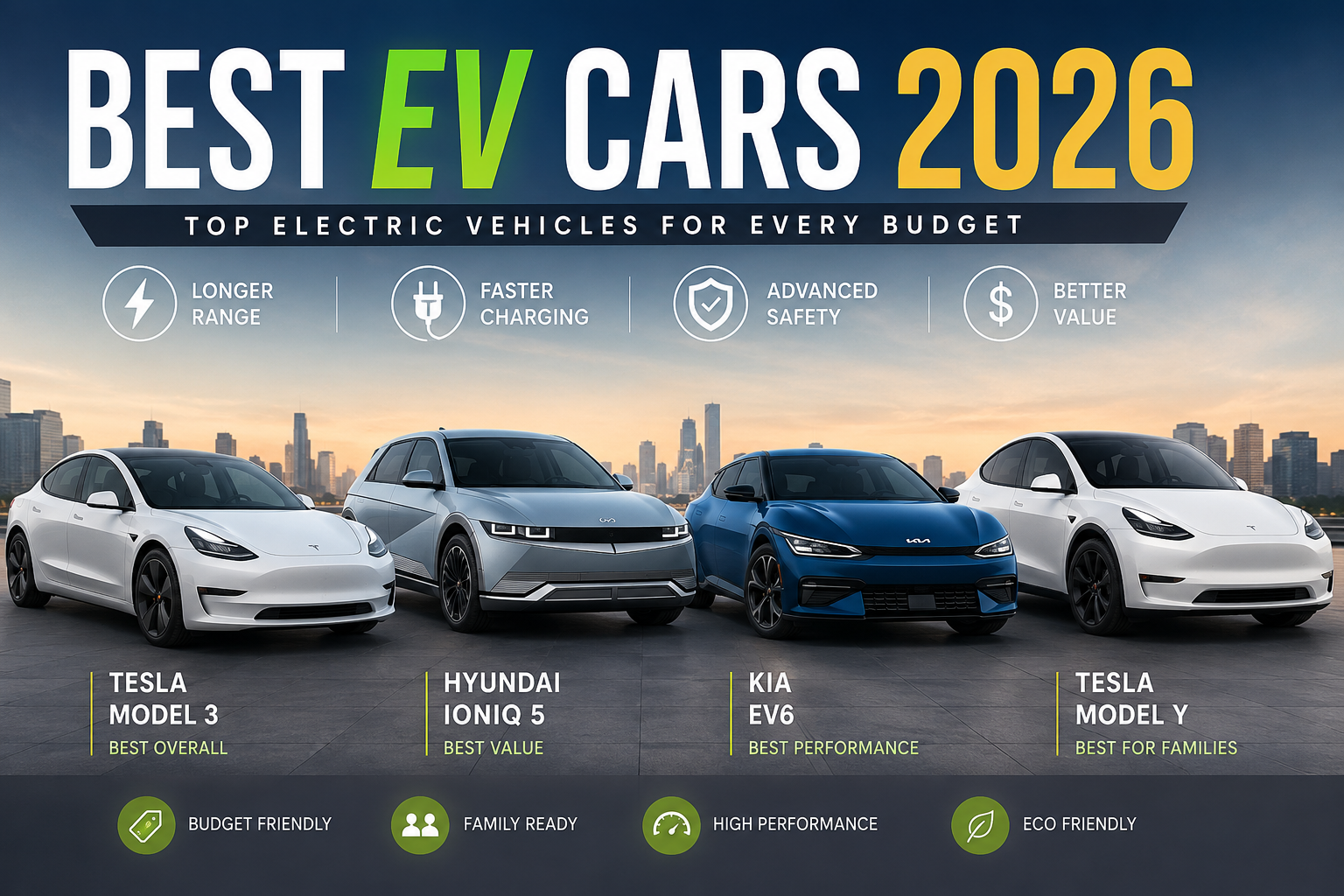
- Best Family EV: Tesla Model Y
- Best Luxury EV: BMW i4
- Best Overall EV: Tesla Model 3
- Best Value EV: Hyundai Ioniq 5
Tips Before Buying Your First EV
- Compare EPA range, not manufacturer marketing numbers.
- Check for state/local incentives now that the federal credit has ended.
- Confirm charging port type (NACS vs CCS) and nearby fast-charger availability.
- Test drive before deciding — ride quality varies a lot between brands.
- Ask about the battery warranty specifically, not just the bumper-to-bumper warranty.
Total Cost of Ownership: What EVs Really Cost Beyond the Sticker Price
The MSRP is only part of the story. When comparing an EV against a gas car — or against each other — it helps to think about five ongoing costs:
- Electricity vs. fuel: Charging at home is almost always cheaper per mile than gasoline, especially if you charge overnight during off-peak utility rates.
- Maintenance: No oil changes, no spark plugs, and less brake wear thanks to regenerative braking, which typically means lower annual maintenance bills than a comparable gas car.
- Insurance: EVs can sometimes cost more to insure than a similar gas car, partly because repair parts (especially battery packs) are pricier and fewer shops are certified to work on them. It’s worth getting an insurance quote before you commit to a specific model.
- Depreciation: EV resale values have historically been more volatile than gas cars, partly because new model years often bring meaningful price cuts (as we’ve seen across the board in 2026), which can push down used values. Tesla and Hyundai models have generally held value better than some competitors.
- Home charger installation: Budgeting $500–$1,500 for a Level 2 home charger and installation is realistic, though the 30C tax credit mentioned earlier can offset some of that cost through mid-2026.
If you’re budgeting for a big purchase like this alongside other financial decisions this year, our business finance guide walks through building a financial foundation that can help you plan around a major purchase like an EV.
Used EVs: A Growing Alternative Worth Considering
With the used EV tax credit now expired and so many 2026 models seeing steep price cuts, the used EV market has become more competitive too — many one- and two-year-old EVs are now priced closer to their new counterparts than usual. If your budget is tight, a lightly used Model 3, Ioniq 5, or Model Y from the last two model years can be a smart way to get most of the technology at a lower price, as long as you check the battery health report and remaining warranty coverage before buying.
Conclusion
The best EV for 2026 depends on your priorities: the Hyundai Ioniq 5 wins on price, the Tesla Model 3 wins on range per dollar, and the Kia EV6 wins on long-term warranty coverage. Compare your daily driving needs against the table above before deciding.
Article updated August 2026 with current U.S. pricing.