
The Best Fluffy Pancakes recipe you will fall in love with. Full of tips and tricks to help you make the best pancakes.

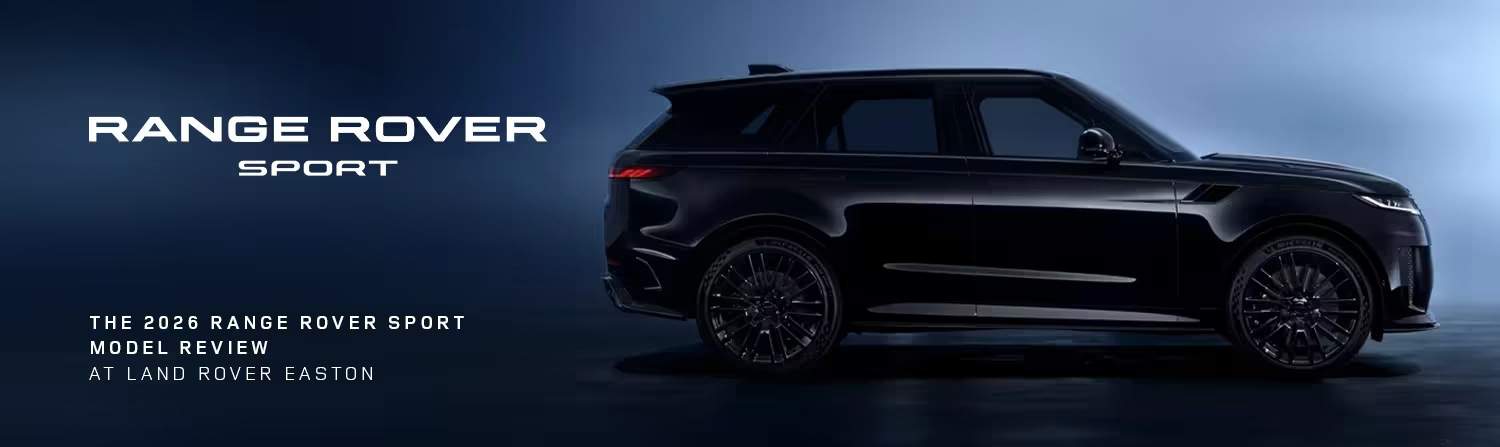
The Range Rover Sport occupies a distinct spot in Land Rover’s lineup — sportier and more driver-focused than the flagship Range Rover, but still carrying the brand’s signature blend of off-road capability and genuine luxury. For 2026, it continues to compete in one of the most demanding segments in the industry: performance luxury SUVs, where buyers expect both true off-road credibility and a cabin that rivals dedicated luxury sedans, without compromising on either front.
This guide breaks down what the 2026 Range Rover Sport offers, who it’s actually built for, and how it stacks up against rivals before you commit to a purchase in this price range.
2026 Range Rover Sport: Quick Facts
[CHECK BEFORE PUBLISHING: Confirm current trim names, starting prices, and powertrain lineup directly on Land Rover’s official configurator, since these details are the most likely to have changed for the current model year.]
- Body style: Mid-size luxury SUV, five-seat configuration
- Powertrain options: Typically includes gas, mild-hybrid, and plug-in hybrid (PHEV) variants, with a high-performance variant at the top of the range
- Drivetrain: All-wheel drive standard across the lineup
- Segment: Performance luxury SUV, competing against the Porsche Cayenne, BMW X5, and Mercedes-Benz GLE
Sport vs. Standard: Same Badge, Different Personality
The core distinction is character rather than capability. The standard Range Rover leans into a more serene, isolated luxury experience — quiet, cushioned, and less overtly performance-focused. The Sport trades some of that isolation for sharper handling, a more engaging driving dynamic, and styling that reads as noticeably more athletic, while still retaining genuine off-road capability and a genuinely luxurious cabin. It’s positioned as the choice for buyers who want Range Rover’s prestige and comfort without fully sacrificing driving engagement.
Under the Hood: Gas, Hybrid, or Something Faster
Land Rover has increasingly leaned into electrified powertrains across the Range Rover Sport lineup, typically offering a spread from efficiency-focused mild-hybrid options up through a plug-in hybrid variant offering meaningful electric-only range for shorter trips and daily commuting, and topping out with a high-performance variant aimed at buyers who want genuine sports-car-adjacent acceleration in an SUV body.
The plug-in hybrid variant in particular has become an increasingly important part of the lineup, since it lets buyers handle short daily trips on electric power alone while retaining a traditional engine for longer journeys or towing — a genuinely practical middle ground for buyers not ready to commit to a fully electric luxury SUV yet.
[CHECK BEFORE PUBLISHING: Confirm current horsepower figures, electric-only range for the PHEV variant, and 0-60 mph times for each trim, as these are frequently updated between model years.]
Interior and Technology
The Range Rover Sport’s cabin emphasizes the kind of understated, high-quality luxury Land Rover has built its modern reputation around — premium materials, a driver-focused layout, and a large central touchscreen handling most infotainment functions. Recent model years have leaned into a cleaner, more minimalist dashboard design, moving more functions into the central touchscreen while retaining some physical controls for frequently used functions like climate control.
Advanced driver-assistance features, adaptive suspension technology, and terrain-response systems that automatically adjust the vehicle’s behavior for different surfaces (mud, sand, rock, snow) remain central to the Range Rover Sport’s identity, reinforcing that genuine off-road capability hasn’t been sacrificed in pursuit of on-road refinement.
On-Road Performance and Off-Road Capability
Reviewers consistently note that the Range Rover Sport manages a genuinely difficult balancing act — a comfortable, controlled ride on pavement combined with real off-road capability that goes well beyond what most buyers in this segment will ever actually use. Adaptive air suspension allows the vehicle to raise or lower its ride height depending on conditions, useful both for off-road clearance and for reducing aerodynamic drag at highway speeds.
The high-performance variant, when equipped, delivers acceleration figures that compete directly with dedicated sports SUVs from rivals like Porsche, while the standard and PHEV variants prioritize a more balanced, comfort-oriented tune suited to daily driving and occasional weekend adventures rather than track-focused performance.
Safety Features and Warranty
The Range Rover Sport typically comes equipped with a comprehensive suite of driver-assistance features standard across the lineup, including adaptive cruise control, lane-keeping assistance, and automatic emergency braking, bringing it in line with expected safety standards for the luxury SUV segment. Land Rover’s standard warranty coverage adds some ownership confidence, though it’s worth comparing specific terms against German rivals, since warranty length and coverage details vary meaningfully between luxury automakers and can factor significantly into long-term ownership costs.
Cayenne, X5, or GLE: How the Sport Stacks Up
The performance luxury SUV segment is unusually competitive, with the Porsche Cayenne generally considered the benchmark for pure driving dynamics, the BMW X5 offering a slightly more tech-forward, driver-focused interior, and the Mercedes-Benz GLE leaning into a more traditionally plush, comfort-oriented luxury experience. The Range Rover Sport’s differentiator remains genuine off-road capability that most rivals in this segment don’t match to the same degree, combined with a design language and brand cachet that carries particular weight for buyers specifically drawn to the Range Rover name.
Buyers cross-shopping this segment should generally expect the Cayenne to win on pure handling feel, the GLE to win on outright cabin comfort, and the Range Rover Sport to win on the combination of off-road ability and design distinctiveness that neither competitor fully replicates.
What Ownership Actually Costs Beyond the Sticker Price
Like most luxury vehicles in this segment, the Range Rover Sport’s total cost of ownership extends well beyond the purchase price. Maintenance and repair costs for luxury SUVs, particularly those with complex air suspension and advanced technology systems, tend to run higher than mainstream SUVs, and it’s worth budgeting for this rather than being caught off guard after the warranty period ends. Insurance costs also typically run higher for luxury and performance vehicles, and it’s worth getting a quote for your specific trim and location before finalizing a purchase decision, since the difference between trims can be substantial.
Is This Actually the Right SUV for You?
This SUV suits buyers who want genuine luxury and strong on-road performance without giving up real off-road capability — someone who might genuinely take the vehicle off pavement occasionally, not just someone drawn to rugged styling alone. It’s also a strong fit for buyers specifically drawn to Land Rover’s brand identity and willing to pay a premium for it, since more affordable rivals exist that match or exceed it in certain individual categories like pure handling or interior tech.
If you’re comparing this against other premium vehicle purchases and want a broader framework for evaluating luxury vehicle value, our Lexus IS 350 F Sport review covers similar considerations — trim differences, options, and what you’re actually paying for — in a different luxury vehicle category.
Who Might Want to Look Elsewhere
Buyers prioritizing outright driving engagement above all else may find the Porsche Cayenne more compelling, while those who rarely or never venture off pavement might find better value in rivals that don’t carry a price premium for off-road capability they won’t use. Land Rover’s reliability reputation has also historically trailed some German luxury rivals, which is worth factoring into a long-term ownership decision alongside the vehicle’s other strengths.
Frequently Asked Questions
Is the Range Rover Sport good off-road? Yes — genuine off-road capability remains a core part of its identity, supported by adaptive air suspension and terrain-response systems, distinguishing it from some rivals in the performance luxury SUV segment that prioritize on-road handling exclusively.
What’s the difference between the Range Rover and Range Rover Sport? The standard Range Rover emphasizes serene, isolated luxury, while the Sport trades some of that isolation for sharper handling and more athletic styling, while retaining genuine luxury and off-road capability.
Does the Range Rover Sport come in a plug-in hybrid version? Typically yes — Land Rover has increasingly offered a PHEV variant in the Range Rover Sport lineup, allowing electric-only driving for shorter trips while retaining a traditional engine for longer journeys.
Is the Range Rover Sport reliable? Land Rover’s reliability reputation has historically trailed some German luxury competitors, which is worth researching and factoring into a long-term ownership decision alongside the vehicle’s performance and luxury strengths.
Conclusion
The 2026 Range Rover Sport remains a compelling choice for buyers who specifically want the combination of genuine off-road capability, strong on-road performance, and Land Rover’s distinctive brand identity — a combination few direct rivals fully replicate. It won’t necessarily win on pure handling against the Porsche Cayenne or interior tech against the BMW X5, but for buyers who value what makes it distinctly a Range Rover, it remains one of the more compelling options in its segment.
For independent testing data and current trim-by-trim pricing, Edmunds’ Range Rover Sport page is a reliable source to check before buying.