
The Best Fluffy Pancakes recipe you will fall in love with. Full of tips and tricks to help you make the best pancakes.

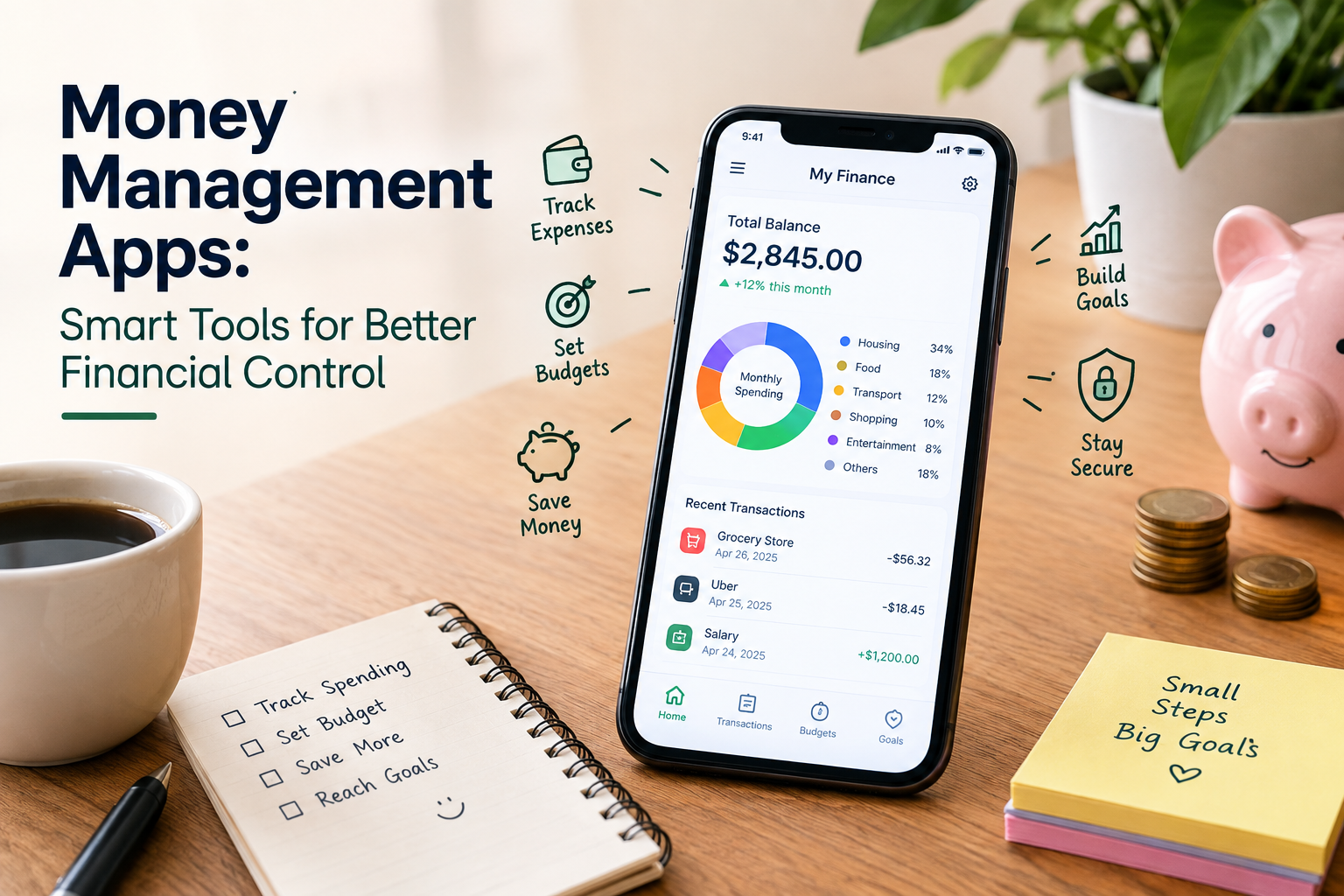
Managing money becomes much easier when you can see exactly where your income goes. Yet many people still rely on mental calculations, scattered notes, or bank statements to keep track of everyday spending.
Money management apps bring budgeting, expense tracking, savings goals, and financial organization into one place. The right app can help you understand your spending habits without turning personal finance into a complicated project.
In this guide, we’ll look at how money management apps work, what features matter most, how to choose one, and how to use these tools without losing control of your financial information.
Table of Contents
ToggleWhat Are Money Management Apps?
Money management apps are digital tools designed to help users organize and monitor their personal finances. Depending on the app, you may be able to track expenses, create budgets, monitor savings, categorize purchases, and review financial trends.
In simple terms, a money management app helps you answer three important questions:
- How much money is coming in?
- Where is my money going?
- Am I making progress toward my financial goals?
Some apps focus mainly on budgeting, while others offer broader financial dashboards. The right app depends on how much control you want and how much of the process you prefer to automate.
For beginners, starting with a simple personal budgeting approach can often be more useful than downloading several financial apps at once.
How Money Management Apps Help You Control Spending
A major benefit of money management apps is that they give you a clear picture of where your money goes.
When purchases are automatically categorized, patterns that are easy to miss become much clearer. You might discover that small food deliveries, subscriptions, transportation costs, or impulse purchases are taking up more of your monthly income than expected.
Track Everyday Expenses
Expense tracking allows you to record purchases and organize them into categories such as:
- Groceries
- Transportation
- Housing
- Entertainment
- Shopping
- Bills
- Dining out
Seeing these categories together can make it easier to identify areas where spending could be adjusted.
Build a Realistic Monthly Budget
A budget works better when it reflects your actual lifestyle. Instead of choosing arbitrary limits, review your previous spending and create categories based on what you realistically earn and spend.
For additional budgeting guidance, readers can also explore how to build an emergency fund as part of a broader financial plan.
Important Features to Look for in a Money Management App
Not every finance app offers the same tools. Before choosing one, think about the features you are most likely to use.
Automatic Expense Categorization
Automatic categorization can save time by sorting transactions into spending groups. However, categories are not always perfect, so you should have the ability to review and correct them.
Budget Alerts and Spending Limits
Notifications can remind you when you’re approaching a spending limit. This is particularly useful for flexible categories where expenses can easily creep upward.
Savings Goal Tracking
Some apps allow users to create specific goals, such as saving for travel, an emergency fund, education, or a major purchase.
Having a visible target can make saving feel more concrete than simply trying to spend less.
Security and Privacy Controls
Financial information is sensitive, so security should be one of your first considerations.
Before connecting an account, check what information the app collects, how it protects your data, and what third-party services it uses. The Consumer Financial Protection Bureau also provides budgeting and financial-management resources for consumers.
Money Management Apps vs. Traditional Budgeting
Managing your finances does not always require a dedicated app. A spreadsheet, notebook, or basic budgeting system can work perfectly well.
The difference is convenience.
Traditional budgeting often requires manually entering transactions and updating totals. Money management apps may automate some of this work, giving you a faster overview of your finances.
When an App Makes Sense
An app may be useful if:
- You have multiple accounts.
- You frequently forget where money was spent.
- You want automatic expense tracking.
- You prefer financial information in one dashboard.
- You are working toward specific savings goals.
When Simple Budgeting May Be Better
You might not need an app if your finances are straightforward and you already maintain a consistent budgeting routine.
Using more financial tools does not necessarily lead to better money management. What matters most is having a simple system that fits your routine and that you can stick with consistently.
Finding a Money Management App That Fits Your Needs
Choosing among dozens of finance apps can feel overwhelming. Start with your financial needs instead of the number of features an app advertises.
Start With Your Main Financial Problem
Ask yourself what you want the app to solve.
If your biggest problem is overspending, prioritize expense tracking and spending alerts. If you’re struggling to save, look for goal-setting features. If you simply want an overview of your finances, a basic dashboard may be enough.
Check Compatibility and Fees
Before signing up, check whether the app works with your devices and financial institutions.
Also look carefully at pricing. Some apps are free, while others use monthly or annual subscriptions. A paid app is only worthwhile if its features provide genuine value for your financial situation.
Review Privacy Policies
Don’t skip the privacy section just because it looks technical.
Understand what financial information the service can access, how long data may be retained, and whether information can be shared with third parties.
For general financial education and consumer guidance, MyMoney.gov is another useful government resource.
Common Mistakes When Using Finance Apps
Money management apps can simplify the way you track your finances, but the important financial choices still remain in your hands.
One common mistake is assuming that an app-created budget is automatically realistic. Your budget still needs regular review.
Another problem is connecting too many accounts or services without understanding what access you’re giving them.
Some users also become overly focused on tracking every small purchase while ignoring larger financial priorities such as high-interest debt, emergency savings, or long-term goals.
Don’t Let Automation Replace Review
Automation is useful, but checking your finances regularly still matters.
Set aside a few minutes each week to review transactions and once a month to compare your actual spending with your budget.
This simple habit can help you catch mistakes and understand whether your financial plan is working.
Are Money Management Apps Worth Using?
Money management apps can be worth using if they make it easier for you to track spending, follow a budget, and work toward financial goals.
Their value depends less on the number of features and more on whether the app fits your habits.
Someone who rarely checks financial information may gain little from a complex dashboard. On the other hand, a person managing multiple accounts or trying to control discretionary spending may benefit significantly from automated tracking.
The important thing is to choose a tool that makes financial management simpler rather than more complicated.
Final Thoughts on Money Management Apps
Good financial management starts with awareness. Once you understand where your money is going, it becomes easier to make informed decisions about spending, saving, and future goals.
Money management apps can provide the organization and visibility needed to build that awareness. However, the app itself is only a tool. Your habits, financial priorities, and regular reviews ultimately determine how useful it becomes.
Start with one clear goal, choose an app that supports it, and give yourself time to develop a consistent routine.
For more practical personal-finance guidance, keep exploring Collective Magzine’s Finance section and build your money-management system one step at a time.

Uzair Hussain
Hey there! I'm Uzair Hussain — a young blogger from
Pakistan with a passion for exploring Health, Tech,
Lifestyle, and Travel topics. I believe that the right
information can change your life. This blog is my way
of sharing what I learn, discover, and experience.
Glad you're here!